
Fabio Zanarello is a Doctoral Fellow at the Centre for Genomic Regulation (CRG) in Barcelona and a proud recipient of the Marie Skłodowska-Curie Actions fellowship within the LongTREC Doctoral Network.
His research centres on developing a framework for annotating genomes across the Tree of Life using long-read RNA sequencing—a cutting-edge approach to capture full-length transcripts and enhance genome annotation across diverse species. Previously, Fabio gained extensive experience in bioinformatics through roles at Illumina in Cambridge, progressing from intern to senior scientist, as well as through strategic placements at the Wellcome Sanger Institute and the European Commission’s Joint Research Centre.
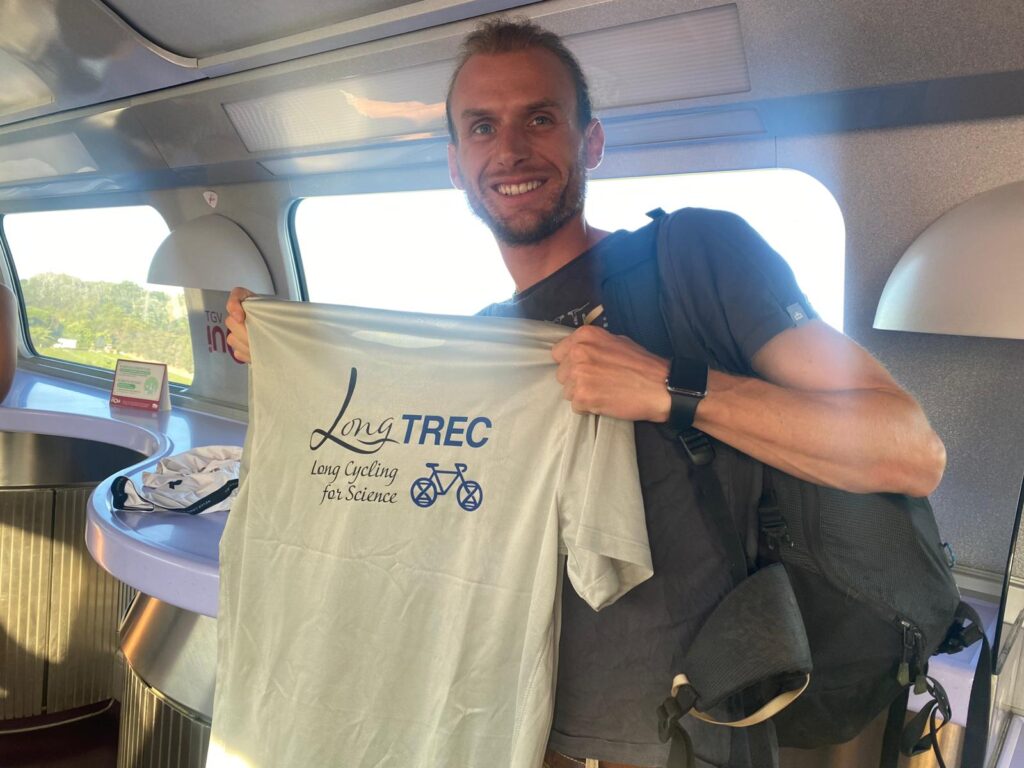
What inspired you to enrol in the long-distance cycling trip?
My passion for the outdoors, reducing my carbon footprint during work travel, and the chance to discuss science with Ana and Nadja outside of the usual seminar rooms were the main drivers. The idea of combining movement, nature, and science felt like a refreshing alternative to the standard academic trip.
How did you plan your route, and what factors did you consider from a sustainability perspective?
For long-distance travel in Europe, trains are by far the most sustainable option—if you can’t cycle all the way. But they’re also the most expensive. To make the trip feasible, we saved money by staying with friends and collaborators in Paris and Cambridge. For the cycling legs, I completely trusted Nadja, who mapped out the best and least trafficked routes. In short: Trainline for trains, Komoot for bikes—the essentials.
What have been the biggest challenges — physical, logistical, or academic — during your trip?
Logistics were definitely the toughest part. Combining train and bike isn’t easy—especially since most fast trains don’t allow bicycles onboard. Renting bikes was the simplest solution. On the administrative side, I was fortunate to have the support of the CRG’s travel team. A big thanks to Rut Carbonell (CRG) and Clara Rodriguez (LongTREC Project Manager), who helped make it all possible.
Beyond our own struggles, I also became more aware of the structural barriers to sustainable travel. Flying remains the default in academia, even though it’s one of the largest contributors to our sector’s carbon footprint. Encouragingly, some funders and institutions are beginning to incentivise more sustainable alternatives. It will be interesting to see how these initiatives evolve.
What message are you hoping to send to the academic community regarding travel and sustainability?
Travel slower. This trip reminded me how meaningful it is to really experience the journey. When you fly across Europe, the airports and planes blur together, and the destination feels disconnected from the path you took to get there. Trains—and especially bikes—make you feel the gradual shift in landscape, culture, and people.
And when you travel with fellow scientists, the journey itself becomes a space for conversation and creativity. On a bike, challenges are inevitable, but the experience of overcoming them together is deeply bonding. Plus, the numbers speak for themselves: trains emit 5–20 times less CO₂ than flights, and cycling is nearly zero.
What kind of reactions have you received from fellow researchers or institutions?
Mostly curiosity and support. A few colleagues told me they were inspired to try something similar. Many asked about the practicalities—how long we spent on the bike, what challenges we faced. They were surprised to hear we rode more than 8 hours from Cambridge to Norwich, and less surprised when they learned the real reason was long chats… and a nap under a tree.
What advice would you give to other students or academics who want to take action but don’t know where to start?
Always check for alternatives. When planning a trip, don’t only look at the fastest and cheapest way. Add other factors into the equation: carbon footprint, comfort, luggage, and even the chance to enjoy the surroundings. You might find a better option than you expected.
Do you have new or more sustainable practices that you would like to share?
I’ve adopted the habit of asking myself: can I do this movement with my legs only? Sometimes the answer is yes, and those are the journeys I remember most fondly. On a smaller scale, I always take the stairs. It’s not a huge environmental gain, but it helps my health—and often inspires others to do the same.
🔗 Relive the whole adventure here: Long Cycling for Science in a Nutshell, from London to Norwich
